.svg)
AI red teaming in HR & Recruitment : Preventing Bias and Decision Manipulation

.png)
Key Takeaways
AI red teaming focuses on how hiring AI fails, not how it performs in ideal conditions.
Resume screening and ranking systems are the highest-risk entry points for manipulation.
Traditional audits miss adversarial behavior that AI security testing in HR reveals.
Silent model drift creates legal and reputational risk in recruitment workflows.
Secure hiring AI requires continuous AI red teaming in HR, not one-time validation.
1. Introduction
Most large companies don’t manually read every resume anymore. They can’t. Volume is too high.
Instead, models sort, rank, and filter. Some predict “fit.” Others score the retention likelihood. Chatbots ask screening questions before a human ever joins the process. In some enterprises, thousands of applicants move through automated decision layers every week.
That scale is efficient. It’s also fragile.
In 2018, Amazon abandoned an internal recruiting model after discovering it systematically downgraded resumes that included indicators associated with women’s colleges. The system had absorbed patterns from historical hiring data and treated them as signals of quality. It wasn’t programmed to discriminate. It learned to.
The lesson wasn’t just about bias. It exposed how invisible these systems can become once deployed. A flawed hiring model doesn’t crash. It keeps running—quietly shaping outcomes.
That’s where AI bias in hiring becomes operational risk. And it’s where deeper AI recruitment security risks start to surface—model drift, feature proxies, and decision thresholds no one stress-tested under pressure.
Who should care? HR leaders. AI governance teams. Compliance officers. Anyone responsible for automated employment decisions.
2. How AI Powers Recruitment Decisions
Ask most recruiters how candidates get shortlisted, and you’ll hear, "The system ranks them first.”
That “system” is usually a stack of models stitched into the hiring workflow.
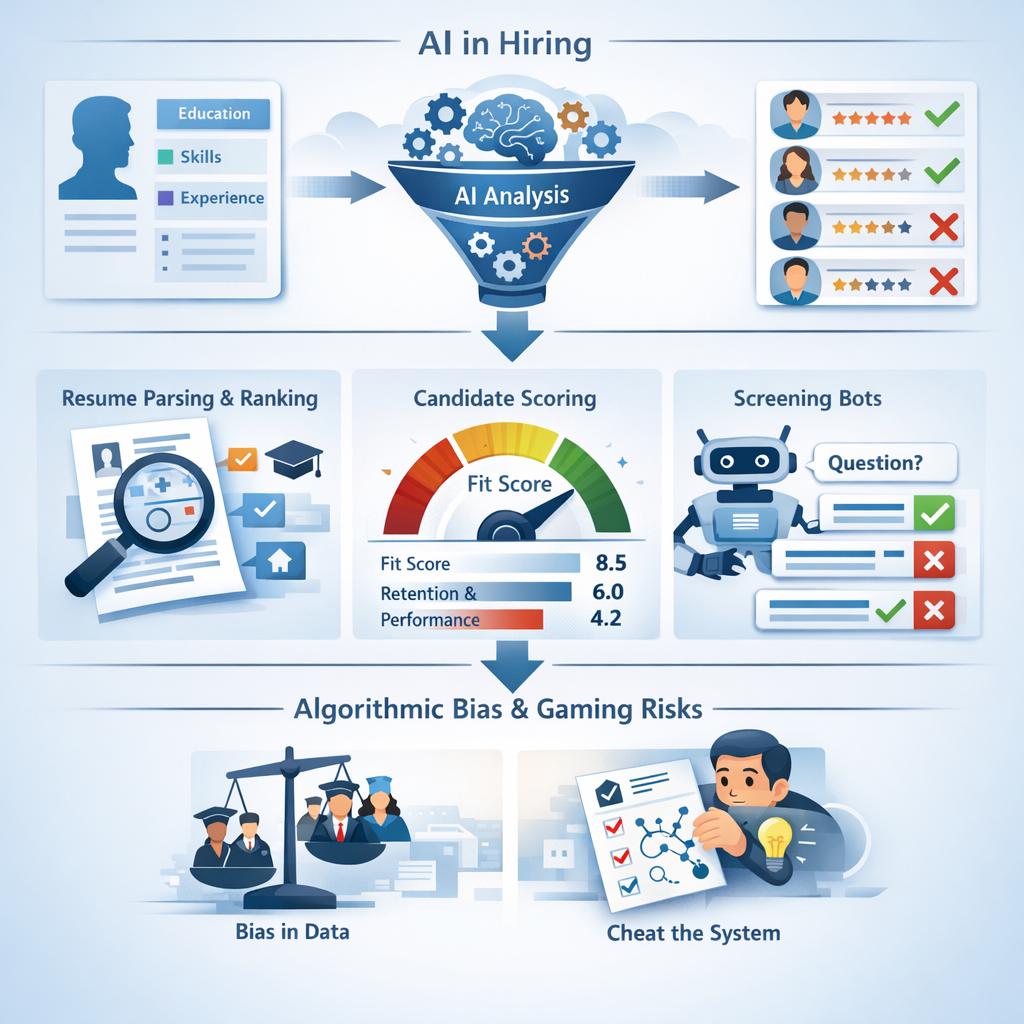
First layer? Resume parsing and ranking. The model extracts keywords, job titles, timelines, and certifications. It compares them against patterns learned from previous hires. If past hires skewed toward certain schools or career paths, then the model treats those signals as “success markers." No one programs discrimination into it. But algorithmic bias in HR often starts with historical data that quietly encodes preference.
Next comes scoring. Some organizations assign internal fit scores. Others predict retention probability or performance bands. These outputs look objective—numbers always do. But thresholds matter. Weighting matters. A small shift in feature importance can reshape who advances. That’s where AI bias in hiring becomes subtle and hard to trace.
Then there are screening bots. They ask structured questions. They filter responses. Sometimes they assess tone or content. Candidates share tips online about how to “beat” these tools. That alone signals exposure. Predictable logic invites gaming—one of the more practical AI recruitment security risks companies underestimate.
This is the operational reality behind AI red teaming in recruitment. Not theory. These systems influence careers daily. And under tightening AI hiring compliance standards, their inner workings can’t remain opaque.
3. AI Red Teaming Use Cases in HR & Recruitment
Most HR teams think about fairness reports. Red teams think about pressure points.
Hiring systems don’t fail loudly. They drift. They get nudged. Sometimes they get gamed. The goal here isn’t to admire the model — it’s to push it until something moves.
3.1 Testing Resume Screening for Disparate Impact
Resume filters rely on patterns from past hiring. That’s normal. The problem is what those patterns reflect.
What red teams test:
⥛ Whether resumes with different names advance at different rates
⥛ The effect of certain universities or locations on the ranking
⥛ How career gaps influence scoring across groups
⥛ Advancement rates broken down by demographic slices
⥛ Combined influence of multiple resume signals
What testing reveals:
Uneven movement through the funnel. Sometimes small. Sometimes not. This is where AI bias in hiring shows up in practice, often tied to historical preferences embedded in data—a common source of algorithmic bias in HR.
3.2 Probing Candidate Scoring for Manipulation
If candidates can guess what a model rewards, they’ll adjust. It happens.
What red teams test:
⥛ Repetition of skills to inflate relevance
⥛ Auto-generated resumes aligned tightly to job posts
⥛ Formatting changes that influence parsing
⥛ Profiles placed near pass/fail cutoffs
⥛ Multiple similar submissions to test consistency
What testing reveals:
How fragile rankings can be. In some systems, minor edits can noticeably change placement. That instability becomes one of the more practical AI recruitment security risks in competitive hiring environments.
3.3 Stress-Testing Screening Bots and Interview AI
Chatbots and automated interviews are decision gates. Candidates learn their rhythm quickly.
What red teams test:
⥛ Attempts to redirect conversation flow
⥛ Answer structures designed to hit scoring cues
⥛ Pushing into restricted question territory
⥛ Reworded responses that test scoring boundaries
⥛ Consistency across similar candidate inputs
What testing reveals:
Scoring logic that shifts under probing. In regulated markets, that matters—especially when AI hiring compliance expectations require predictable, explainable behavior.
3.4 Evaluating End-to-End Hiring Pipelines
A hiring pipeline isn’t one model. It’s a chain.
Resume ranking affects scoring pools. Scoring affects interviews. Interviews shape offers. Small distortions early on don’t stay small.
What red teams test:
⥛ Whether disparities widen at each stage
⥛ Threshold changes during urgent hiring pushes
⥛ Model behavior shifts over time
⥛ Completeness of decision logs
⥛ Frequency and patterns of manual overrides
What testing reveals:
weak links between systems. That’s where AI red teaming in HR becomes about overall system behavior, not just individual model outputs.
3.5 Simulating Insider Threat and Administrative Abuse
Internal controls can be just as sensitive as external inputs.
Recruitment platforms usually allow overrides and configuration changes. In busy cycles, governance around those controls can loosen.
What red teams test:
⥛ Undocumented score overrides
⥛ Temporary cut-off changes
⥛ Access rights that exceed role needs
⥛ Missing or incomplete audit entries
⥛ Parallel workflows outside official tracking
What testing reveals:
Operational gaps that expand broader AI recruitment security risks, even when candidate behavior is clean.
3.6 Testing Fairness Metric and Compliance Manipulation
Fairness dashboards are useful. They can also create blind spots if trusted blindly.
What red teams test:
⥛ Threshold tuning to reach target ratios
⥛ Selective demographic reporting
⥛ Fairness checks run on incomplete samples
⥛ Differences between test and live environments
⥛ Quiet metric definition changes
What testing reveals:
A gap between reported performance and actual system behavior. That gap becomes critical under employment regulations and reinforces the need for AI red teaming in recruitment beyond surface-level checks.
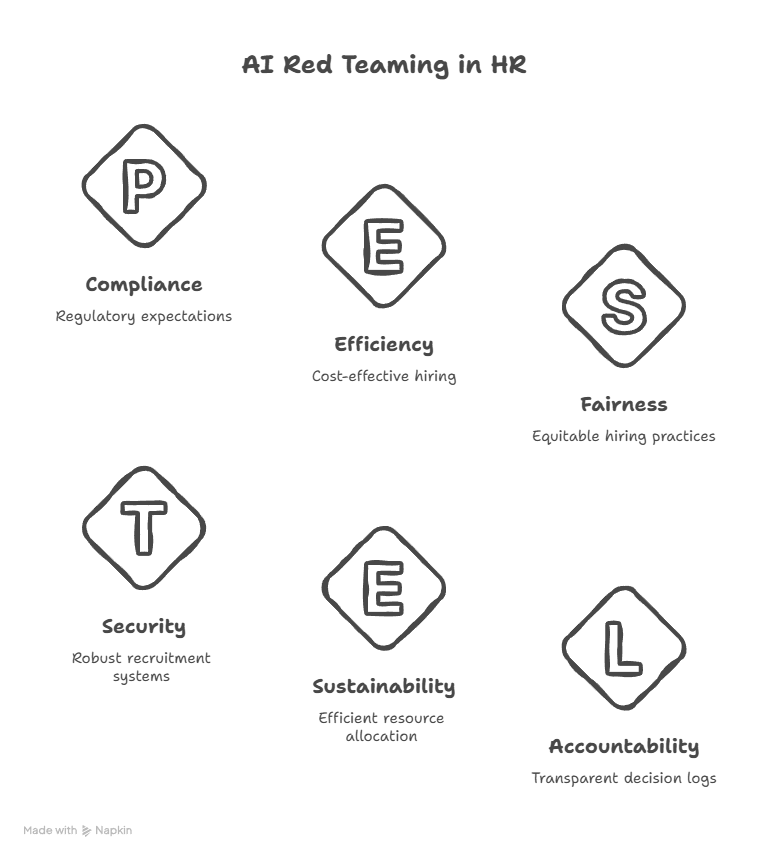
4. How Recruitment AI Fails Under Adversarial Pressure
Hiring systems rarely collapse. They misfire quietly.
Here’s how that usually happens.
Attack Pattern 1: Resume Gaming
What does resuming gaming look like in practice?
Candidates reverse-engineer the filter.
If a system ranks based on keyword frequency or role similarity, applicants adapt. They mirror job descriptions. They repeat core skills. Some even use AI tools to tailor resumes precisely to the posting language.
Why does it work?
Because many screening models reward pattern density, not contextual strength. When thresholds are predictable, small wording changes can shift ranking positions.
This doesn’t always break the system. It distorts it. Over time, that distortion feeds hiring data back into the model—reinforcing noisy signals and increasing downstream AI recruitment security risks.
Attack Pattern 2: Proxy Variable Bias
Why do neutral variables sometimes create unequal outcomes?
Because proxies behave like stand-ins.
A university name may correlate with socioeconomic status. A gap in employment may correlate with caregiving. A location can indirectly reflect demographic patterns. The model doesn’t “see” protected categories. It doesn’t need to.
When these correlations influence ranking or scoring, the result can resemble AI bias in hiring, even without explicit discriminatory features. This is one way algorithmic bias in HR persists despite technical safeguards.
Attack Pattern 3: Threshold Manipulation and Drift
What happens when hiring pressure increases?
Cutoffs move.
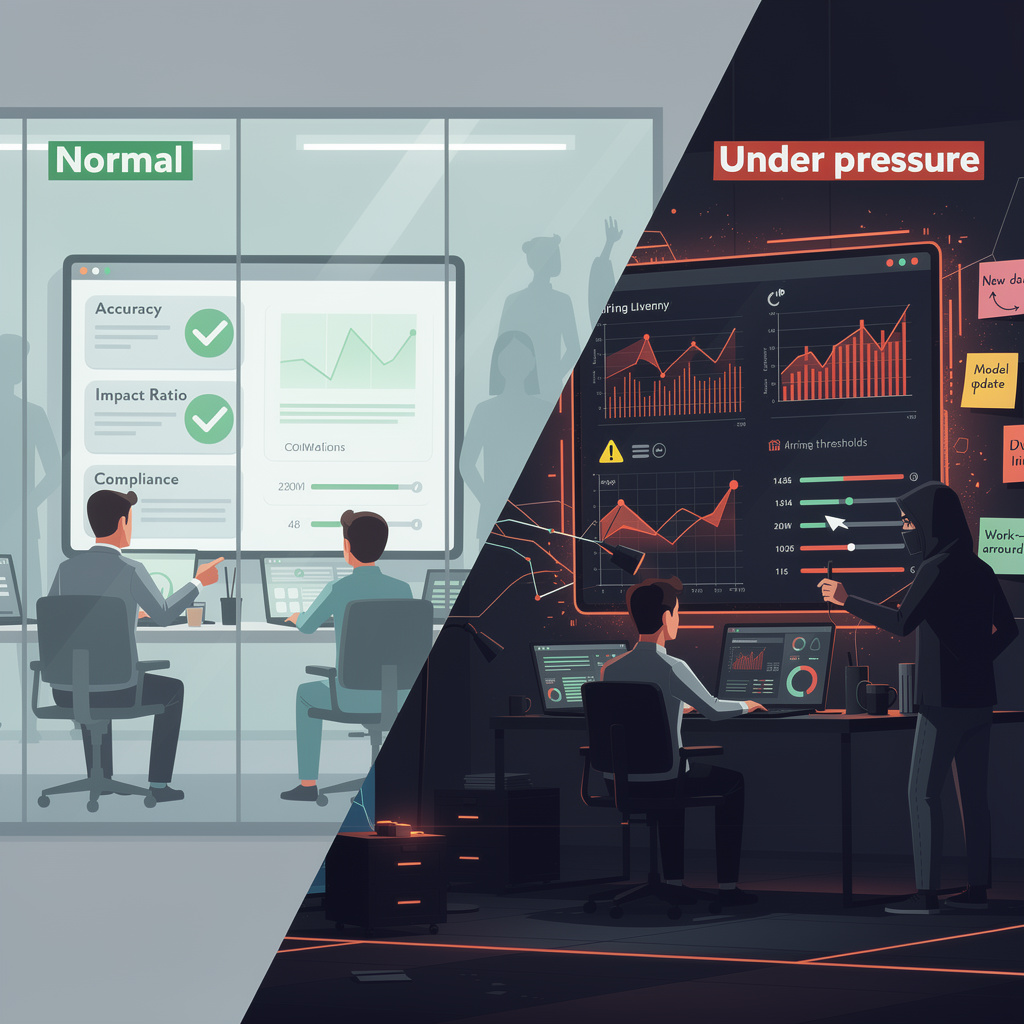
During rapid hiring cycles, teams sometimes adjust score thresholds to widen candidate pools. That seems operationally harmless. But repeated adjustments—especially without documentation—shift system behavior over time.
Add model drift to the equation. Data distributions change. Skill demand shifts. Labor markets evolve. If models aren’t recalibrated under stress testing, decision boundaries quietly shift.
That’s why AI red teaming in HR focuses on “pressure scenarios," not just steady-state performance. And it’s why AI red teaming in recruitment treats hiring AI as a dynamic system—one that changes under load, incentives, and real-world use.
5. Why Traditional AI Audits Miss These Risks
Most hiring systems get audited. Fewer get challenged.
Why do standard audits miss real weaknesses?
Because they measure outputs under normal conditions.
Typical reviews check accuracy, adverse impact ratios, documentation, and policy alignment. That’s necessary. But it assumes the system behaves the same way under pressure as it does in testing environments.
It doesn’t.
Why else do gaps remain?
Because audits are usually static snapshots. Hiring systems evolve. Data shifts. Recruiters adjust thresholds. Models get retrained. Small operational changes rarely trigger a full reassessment.
And one more issue: compliance checklists focus on declared design, not adversarial behavior. A model can pass fairness metrics and still be easy to game. It can meet documentation standards and still drift over time.
That’s the blind spot.
This is where AI red teaming in HR differs. It doesn’t ask whether the system meets baseline requirements. It asks how the system behaves when pushed—technically, operationally, and procedurally.
6. Implications for HR Leaders and Governance Teams
If hiring software makes employment decisions, it needs more than a compliance checklist.
Start by pressure-testing it. Not once. Regularly. Hiring data changes. Labor markets shift. Thresholds get adjusted during busy quarters. Systems don’t stay static.
Next, stop treating fairness and security as separate tracks. A model that can be manipulated can also produce biased outcomes. The risks overlap more than most teams admit.
Then look at ownership. Who can change thresholds? Who can override scores? Are those actions logged and reviewed? Governance gaps often show up outside the model itself.
Finally, move beyond surface metrics. Passing a fairness ratio doesn’t mean the system behaves predictably under stress. That’s why AI red teaming in HR—and more specifically AI red teaming in recruitment—has become part of responsible oversight, not just technical experimentation.
7. Conclusion
Hiring systems now sit in the critical path of employment decisions. They filter. Rank. Score. Advance. Often before a human intervenes.
When they drift, get manipulated, or quietly encode historical bias, the impact isn’t abstract. It affects real candidates and exposes real organizational risk.
That’s the shift. AI red teaming in recruitment is not just about model accuracy. It’s about pressure-testing decision systems that influence livelihoods. And AI red teaming in HR pushes organizations to look beyond dashboards and into how their systems behave when stressed.
Treat hiring AI like infrastructure. Because that’s what it has become.

“Hiring AI rarely breaks, it quietly decides who never gets a chance.”


Make AI red teaming a Core Control for Hiring & Recruitment AI With WizSumo

.png)
.svg)

.png)
.png)


