.svg)
CBRN Risk
1. Understanding the Attack
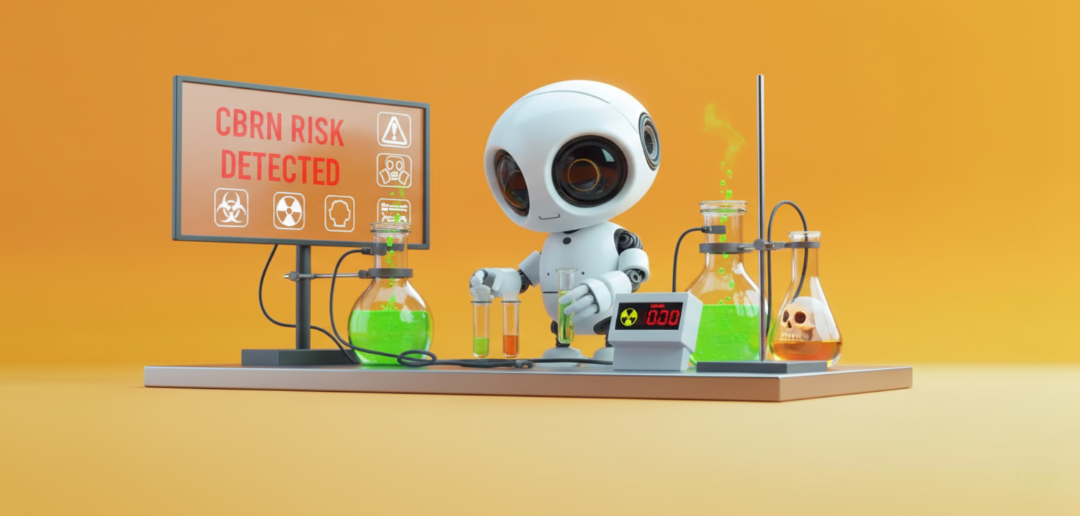
CBRN Risk refers to how AI systems can unintentionally assist or accelerate activities involving Chemical, Biological, Radiological, or Nuclear threats when their capabilities or outputs are misused.
2. Why This Vulnerability Occurs (Improved, Stronger Reasons)
⮞ AI can combine fragmented scientific knowledge into actionable clarity
Even if information is scattered or technical, AI can synthesize it into simpler explanations that lower the difficulty of understanding sensitive topics.
⮞ Rapid scaling of analysis and generation
AI can process thousands of documents, patterns, or scenarios instantly, amplifying the speed and scale at which sensitive insights might be produced.
⮞ Misleading confidence and hallucinations
Models sometimes generate confident, authoritative answers — even when incorrect — which may give dangerous false impressions about hazardous scientific processes.
⮞ Ambiguous user intent is difficult to detect
Malicious queries can be disguised as academic, professional, or hypothetical questions, making it hard for simple filters to distinguish intent.
⮞ Open-source or widely accessible models lack strong guardrails
Models released without strict safety controls can be modified, fine-tuned, or exploited by actors seeking harmful knowledge.
3. Examples
⮞ An AI model summarizing open scientific literature into an overly simplified “steps list” for handling dangerous substances.
⮞ A model unintentionally generating harmful-sounding technical suggestions when tested by safety evaluators.
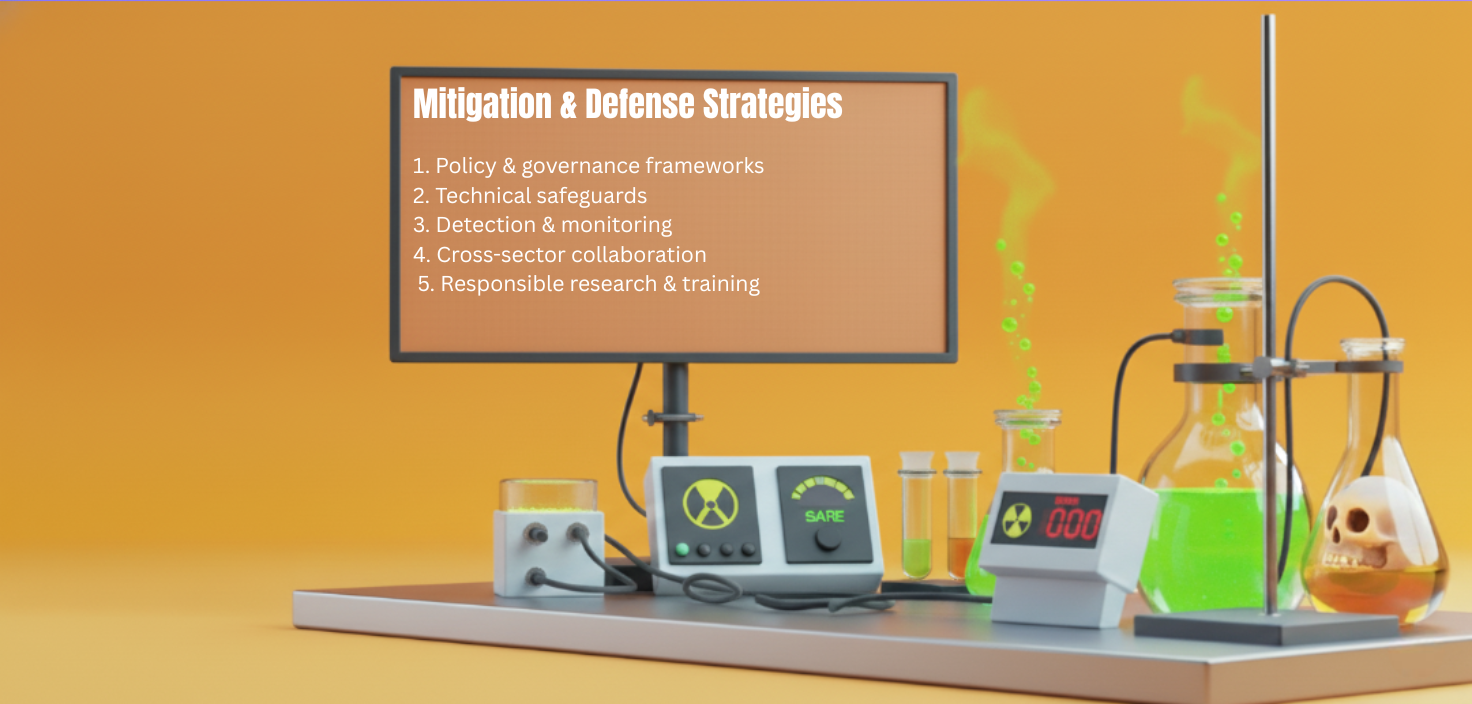
4. Mitigation & Defense Strategies
⮞ Policy & governance frameworks
Define which AI capabilities are high-risk and require restricted access and oversight.
⮞ Technical safeguards
Use red-teaming, filters, model evaluations, and human-in-the-loop checks to detect and block risky outputs.
⮞ Detection & monitoring
Identify abnormal patterns or harmful intent early through monitoring and behavioral analytics.
⮞ Cross-sector collaboration
Encourage shared standards, reporting channels, and best practices across governments and industry.
⮞ Responsible research & training
Educate AI developers and scientists about dual-use risks and safe publication practices.
5. Real-World Incidents
⮞ Incident 1 (2024-25): AI model and biological risk acknowledgement — Major AI developers disclosed that internal testing found their models might generate unsafe biological information, prompting stricter safety protocols.
⮞ Incident 2 (2025): Dietary misuse via AI advice — A 60-year-old man reportedly replaced table salt (sodium chloride) with sodium bromide after consulting an AI chatbot. He developed “bromism” (bromide poisoning) with paranoia and hallucinations, was hospitalised, and the incident was documented in a medical case report; the AI tool’s guidance lacked context, health-warnings, or professional oversight.
6. Guardrails
⮞ Prevent biological weapon assistance: Block harmful biological or lab-style outputs.
⮞ Prevent chemical weapon guidance: Disallow any chemical synthesis or hazardous chemical details.
⮞Control nuclear information: Restrict nuclear-related questions and sensitive material.
⮞ Block autonomous weapon development help: Deny queries about targeting or automated weapon decisions.
⮞ Protect critical infrastructure: Prevent outputs that reveal vulnerabilities in essential systems.
7. Final Thoughts
AI’s ability to analyze, generalize, and simplify complex scientific information makes CBRN risk a top safety priority, requiring strong technical safeguards, governance, and coordinated global response.
Heading about sub attacks
.png)

.svg)

.png)
.png)
.png)
.png)
.png)
.png)
.png)
.png)
.png)
.png)

Sources
All major AI models risk encouraging dangerous science experiments - https://www.newscientist.com/article/2511098-all-major-ai-models-risk-encouraging-dangerous-science-experiments/
Dietary misuse via AI advice - https://www.nbcnews.com/tech/tech-news/man-asked-chatgpt-cutting-salt-diet-was-hospitalized-hallucinations-rcna225055

.png)
.jpg)
.png)
.png)
%20(1).png)
.jpg)
.png)
.jpg)
.png)


