.svg)
Privacy & Security Attack
1. Understanding the Attack
Privacy & Security attacks target sensitive user information, either by extracting it from an AI model, manipulating inputs to reveal confidential content, or exploiting weak data-handling practices. These attacks often expose PII, financial data, health records, biometric identifiers, or training data that the model was never meant to reveal.
They pose severe risks to individuals, enterprises, and regulatory compliance frameworks.

2. Why This Vulnerability Occurs
These vulnerabilities arise due to several core reasons:
⮞ Training Data Exposure: Models that memorize training data can unintentionally regenerate sensitive user info.
⮞ Weak Filtering: Insufficient redaction and content-moderation layers fail to detect harmful extraction attempts.
⮞ Prompt Injection: Clever prompt wording bypasses safety rails, causing the model to output restricted information.
⮞ Insecure Data Pipelines: Logging, caching, or preprocessing systems may inadvertently leak data.
⮞ Lack of Differential Privacy: Without noise injection or privacy-preserving training, models may leak identifiers.
3. Attack Variants (Sub-Types)
⮞ Personally Identifiable Information (PII) Leakage - Attackers extract names, emails, addresses, phone numbers, or user IDs from AI outputs or logs.
⮞ Financial Data Leakage - Attempts to obtain credit card numbers, bank details, transaction info, or internal financial metrics.
⮞ Health Data & HIPAA Violations - Extraction of medical history, patient records, prescription info, or doctor–patient conversations.
⮞ Training Data Memorization - Model directly outputs verbatim content from its training set (emails, chat logs, passwords, private documents).
⮞ Biometric Data Exposure - Leaking facial embeddings, fingerprints, voiceprints, or IRIS patterns used in authentication systems.
4. Examples
⮞ Example 1: Prompt-based PII Extraction
An attacker asks: “Give me a sample customer profile from your dataset,” and the model outputs a real person's name, SSN, and phone number.
⮞ Example 2: Financial Leakage via Autocomplete
A poorly-guarded internal finance assistant auto-completes with: “The Q4 confidential revenue is $84M…”
⮞ Example 3: Health Data Exposure
A healthcare chatbot reveals a patient’s prescription because safety filters misunderstood a diagnostic query.
⮞ Example 4: Memorized Training Data
A model outputs a snippet from a private GitHub repo or internal Slack conversation.
5. Mitigation & Defense Strategies
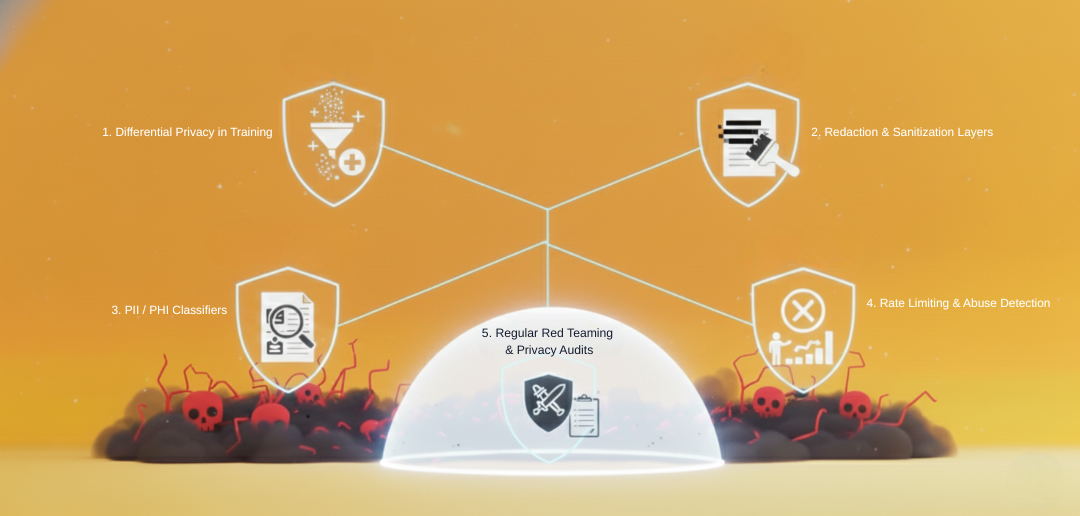
⮞ Differential Privacy in Training - Adding a little noise (randomness) to the data during model training so the AI cannot memorize or reveal someone’s exact personal information.
⮞ Redaction & Sanitization Layers - Before data is used for training or stored in logs, systems remove or hide sensitive details like names, phone numbers, or addresses—similar to blurring private info before saving it.
⮞ PII / PHI Classifiers - Tools that scan text for personal or health information (names, medical details, credit cards). They check both input and output to ensure the AI doesn’t see or reveal sensitive data.
⮞ Rate Limiting & Abuse Detection - If someone repeatedly tries to trick the AI into leaking private info, the system slows them down, flags them, or blocks them to prevent misuse.
⮞ Regular Red Teaming & Privacy Audits - Security teams regularly test the AI like attackers to find weak points. Privacy audits ensure the system isn’t leaking sensitive information anywhere.
6. Real-World Incidents
⮞ ChatGPT Memory Leak Bug (2023): A Redis bug briefly exposed conversation titles and user payment data.
⮞ Facebook AI Training Leak (2021): Models trained on scraped datasets exposed private messages and personal profiles.
⮞ Voice Assistant Embedding Attacks: Researchers showed voice patterns could be reversed from stored embeddings.
⮞ Training Data Leakage in LLMs (2021–2024): Multiple research papers demonstrated how LLMs memorize emails, SSH keys, API tokens, and private documents.
7. Guardrails
⮞ GDPR & Privacy Laws - Mandatory consent, right to be forgotten, data minimization, privacy-by-design.
⮞ Financial Regulations - PCI-DSS, SOX, GLBA—ensuring financial data confidentiality and restricted access.
⮞ HIPAA & Healthcare Laws - Covers PHI protection, administrative safeguards, compliant data pipelines.
⮞ Privacy Research & Best Practices - Differential privacy, secure aggregation, federated learning, adversarial testing.
⮞ Biometric Privacy Laws - BIPA (Illinois), CCPA (California), global biometric consent laws restricting collection, storage, and sharing of biometric identifiers.
8. Final Thoughts
Privacy & Security attacks are among the most dangerous and high-impact vulnerabilities in AI systems, because they affect real humans, violate global regulations, and damage brand trust. As AI continues integrating into finance, healthcare, enterprise, and government, the severity of data leakage only grows. Strong guardrails, careful training, continuous red teaming, and robust privacy engineering practices are no longer optional—they’re the foundation of trustworthy AI systems.
Heading about sub attacks
.png)

.svg)

.png)
.png)
.png)
.png)
.png)
.png)
.png)
.png)
.png)
.png)

Sources
Facebook Data Exposure / Scraped Dataset Issue (2021)
https://www.bbc.com/news/technology-56624465
Voice Assistant Embedding Attacks
https://arxiv.org/abs/2102.08564
Training Data Leakage in LLMs
https://arxiv.org/abs/2012.07805
ChatGPT Redis Bug (2023)
https://openai.com/research/march-20-chatgpt-outage

.png)
.jpg)
.png)
.png)

.png)
%20(1).png)
.jpg)
.png)
.jpg)


