.svg)
Transparency & Explainability
1. Understanding the Attack
Transparency & Explainability attacks occur when AI systems operate like “black boxes,” offering no clarity on how decisions are made, what data influenced them, or what limitations they have. This lack of visibility allows mistakes, biases, and harmful outputs to go unnoticed—and makes it impossible for users to judge whether the system is reliable.

2. Why This Vulnerability Occurs
⮞ Opaque Model Architectures - Modern large models are extremely complex, making internal reasoning difficult to interpret.
⮞ Limited Training Data Disclosure - Companies rarely share the datasets or sources used, leading to uncertainty about bias, safety, and legality.
⮞ Insufficient Documentation - Model cards, changelogs, and safety notes are often incomplete, outdated, or completely missing.
⮞ No Mechanism for Output Explanation - Models can produce confident answers without providing reasoning or evidence.
⮞ Safety & Compliance Pressure - Companies hide key information due to competitive, regulatory, or security concerns.
3. Examples
⮞ Undocumented Bias - A model denies loan eligibility to a minority group because of hidden skewed training data, but provides no explanation.
⮞ Hallucinated Justifications - The model gives false reasoning (e.g., "legal references" that don’t exist) because it cannot explain actual internal logic.
⮞ Mismatched Capability Disclosure - Documentation says the model cannot write code, but the model actually can—leading to unsafe usage.
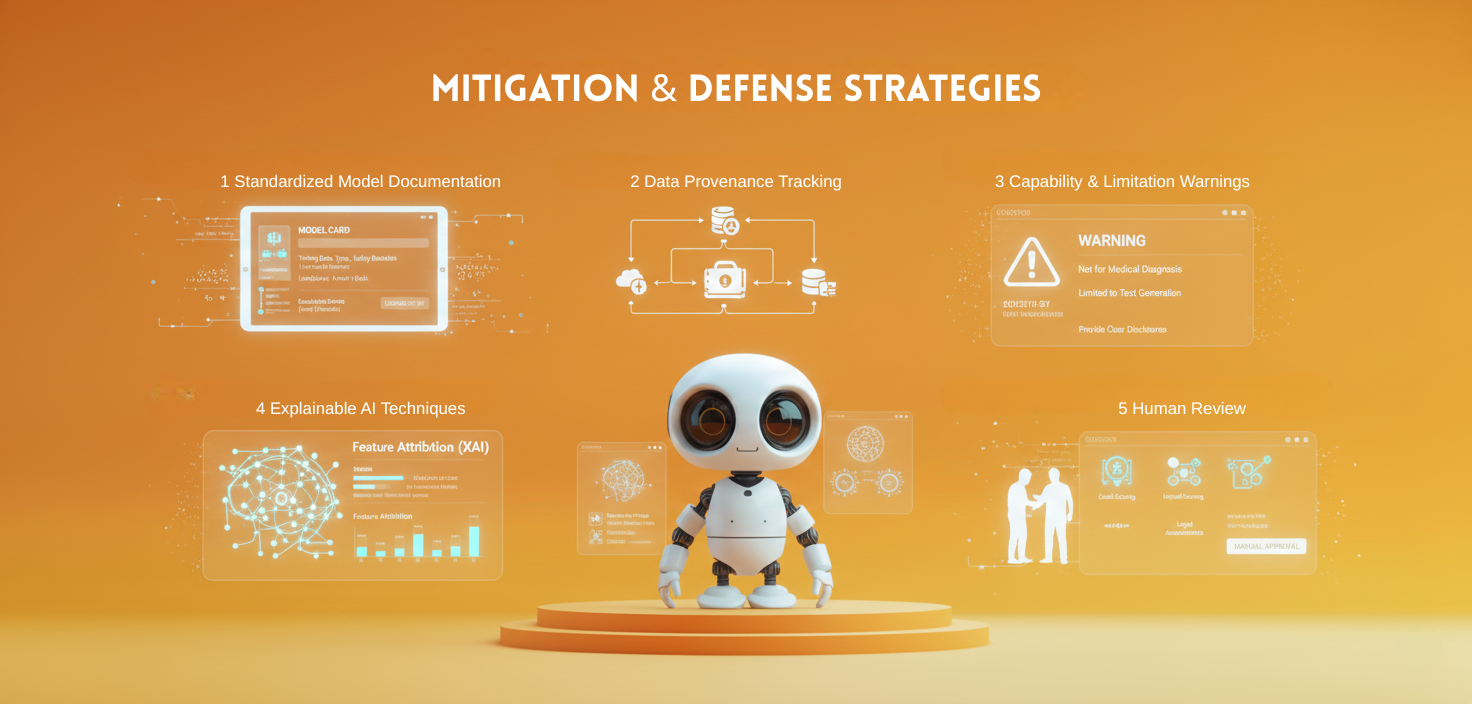
4. Mitigation & Defense Strategies
⮞ Standardized Model Documentation - Use detailed model cards with training data type, safety datasets, known limitations, risk notes, evaluation scores.
⮞ Data Provenance Tracking - Track and record the sources, categories, and licenses of training data.
⮞ Capability & Limitation Warnings - Provide clear disclosures, in-product hints, and risk notices on what the AI can and cannot do.
⮞ Explainable AI Techniques (XAI) - Use saliency maps, feature attribution tools, chain-of-thought masking, or evidence tracing to justify decisions.
⮞ Human Review for High-Risk Use Cases - Manual approval for credit scoring, medical interpretation, legal assessments, etc.
5. Real-World Incidents
Incident 1 – Lack of explainability in dermatology AI algorithms
In the medical domain, studies found that many AI tools trained for dermatological diagnosis did not make their training data or decision logic available. In one review, “most data used for training and testing AI algorithms in dermatology were not publicly available,” creating major transparency and trust problems.
Because doctors and patients could not understand the basis of the model’s predictions, it was difficult to assess risks of bias
Incident 2 – Proprietary criminal-justice risk assessment algorithm
A well-known case involves a risk-assessment algorithm used in the U.S. criminal-justice system. The proprietary nature of the model meant defendants and their attorneys could not inspect the logic or data behind the “risk score”—raising serious fairness concerns.
6. Guardrails
⮞ Standardized Documentation Templates - Ensure every model has a consistent, comprehensive, and auditable documentation format.
⮞ Data Provenance Tracking - Track the origin, license, and category of all training data to prevent bias and legal issues.
⮞ Capability Documentation & Limitation Warnings - Prevent misuse by clearly stating what the model can do, cannot do, and should never be used for.
⮞ Explainable AI Techniques - Provide traceable reasoning, evidence, or feature attribution for high-risk decisions.
7. Final Thoughts
Transparency & Explainability attacks weaken trust, increase safety risks, and make AI systems unpredictable. To build reliable AI—especially for high-stakes domains—teams must prioritize visibility into how the model works, what data shaped it, and why it makes certain decisions. Guardrails like standardized documentation, provenance tracking, capability disclosures, and XAI techniques ensure AI remains accountable, safe, and trustworthy.
Heading about sub attacks
.png)

.svg)

.png)
.png)
.png)
.png)
.png)
.png)
.png)
.png)
.png)
.png)

Sources
Lack of explainability in dermatology AI algorithms - https://pmc.ncbi.nlm.nih.gov/articles/PMC12481837/
Proprietary criminal-justice risk assessment algorithm - https://mallika-chawla.medium.com/compas-case-study-investigating-algorithmic-fairness-of-predictive-policing-339fe6e5dd72

.png)
.jpg)
.png)
.png)

.png)
%20(1).png)
.png)
.jpg)
.png)


