.svg)
Domain Specific Attacks
1. Understanding the Attack
Domain-specific attacks happen when an AI system unintentionally provides regulated professional advice—such as medical, legal, financial, or educational guidance—without the qualifications, disclaimers, or safety checks that real experts are required to have. These situations create legal exposure, safety risks, and misinformation, especially when users treat the AI’s confident responses as authoritative.

2. Why This Vulnerability Occurs
⮞ Over-generalized model behavior: LLMs answer confidently across domains even when expertise is required.
⮞ Poor detection of regulated topics: The system fails to recognize when a question enters a domain with strict rules.
⮞ Incorrect interpretation of user intent: Harmless questions and high-stakes advice requests can look similar to the model.
⮞ Regulatory variation across countries: AI may respond without applying the correct jurisdiction’s rules.
⮞ Missing or inconsistent disclaimers: Users may assume AI is a certified expert if disclaimers are not applied.
⮞ Ambiguity in prompts: Vague or incomplete queries lead the model to provide unsafe or specific recommendations.
3. Examples
Example 1: Unsafe Medical Guidance
A user asks, “What dosage of XYZ medicine should I take?” and the AI directly recommends a dosage, ignoring medical history, allergies, or safety protocols.
Example 2: Unlawful Investment Predictions
An AI tells a user, “Invest in ABC stock today, it will double soon,” which can mislead users and violate financial regulatory standards.
4. Mitigation & Defense Strategies
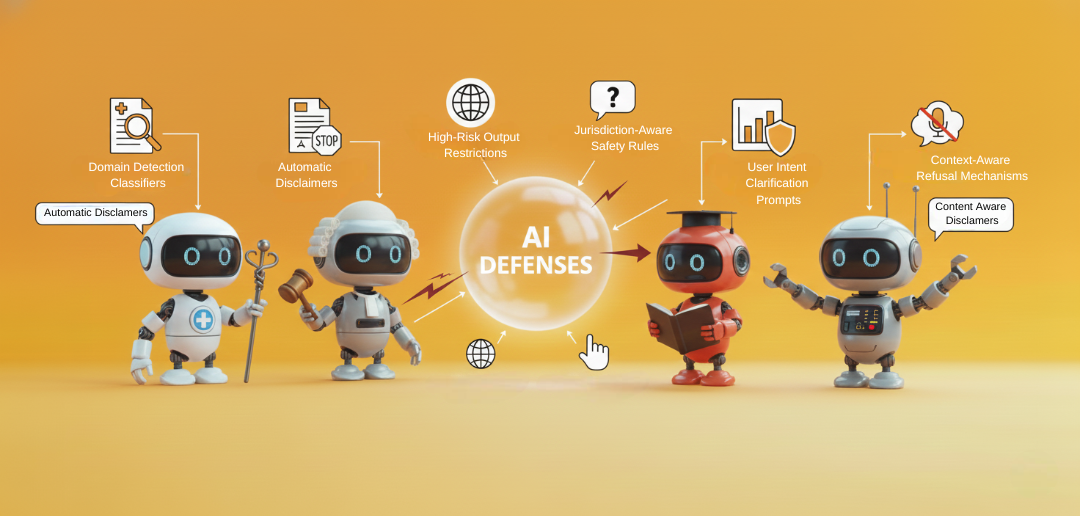
Domain Detection Classifiers
Identify when a query belongs to a regulated area like medicine, law, finance, or education.
Automatic Disclaimers
Automatically attach safety disclaimers when responding to regulated-domain questions.
High-Risk Output Restrictions
Block unsafe outputs such as drug dosages, legal clauses, or financial predictions.
Jurisdiction-Aware Safety Rules
Apply region-specific regulatory requirements to avoid illegal or unlicensed advice.
User Intent Clarification Prompts
Ask follow-up questions when user intent may involve high-stakes professional guidance.
Context-Aware Refusal Mechanisms
Refuse answers that only certified professionals are legally allowed to provide.
5. Real-World Incidents
Incident 1: Harmful Medical Suggestion
A popular LLM reportedly advised a parent on incorrect antibiotic dosages for a child, raising immediate safety and regulatory concerns among healthcare reviewers.
Incident 2: Unauthorized Financial Advice
Screenshots surfaced online showing an AI recommending volatile cryptocurrency investments as “safe long-term choices,” a clear violation of financial advisory rules.
6. Guardrails
⮞ Medical Advice: Automated disclaimers and medical content flags.
⮞ Investment Advice: Investment disclaimers and qualification checks.
⮞ Educational Content: Age verification and content filtering.
⮞ Legal Practice: Legal advice disclaimers and limitation notices.
7. Final Thoughts
Domain-specific attacks highlight how easily AI can overstep into regulated professions, unintentionally providing advice that should only come from certified experts. These errors create safety hazards, legal liability, and user harm. With strong guardrails—like domain detection, disclaimers, output restrictions, and refusal mechanisms—AI systems can stay safe, compliant, and responsibly aligned with regulations.
Heading about sub attacks
.png)

.svg)

.png)
.png)
.png)
.png)
.png)
.png)
.png)
.png)
.png)
.png)

Sources
A popular LLM reportedly advised a parent on incorrect antibiotic dosages for a child - https://pmc.ncbi.nlm.nih.gov/articles/PMC5610049/
Unauthorized Financial Advice - https://www.home.saxo/content/articles/commodities/ai-and-crypto-stumble-heightens-volatility-risk-for-in-demand-investment-metals-18112025

.png)
.jpg)
.png)
.png)
.png)
%20(1).png)
.jpg)
.png)
.jpg)
.png)


